

As businesses increasingly leverage data to drive growth, AI-assisted ICP-driven list building has
become a cornerstone for not only targeted marketing but also revenue generation and sales
strategies. By analyzing large datasets from sources such as CRM, customer support and
service, and ERP systems, as well as third-party data, AI uncovers patterns that inform
decision-making and lead-generation efforts.
However, there is a significant risk: Can AI hallucinate an ICP? The short answer: Yes!
If not carefully managed, AI can generate profiles that seem plausible but don’t align with your
ideal customers’ actual needs, leading to wasted resources and missed revenue opportunities.
In this blog, we’ll explore the risks of AI hallucinations in B2B data, why they occur, and how
custom list-building services can help ensure your ICP is both accurate and revenue-aligned,
maximizing your sales and marketing efficiency.
What is an AI-Hallucinated Ideal Customer Profile?
An AI-hallucinated ICP refers to a customer profile generated by AI that doesn’t accurately
reflect your ideal customer. While the AI model may appear to identify prospects based on
patterns, these profiles often do not align with real buyer personas, leading to misdirected sales
efforts.
For example, AI might create profiles based on outdated or biased data, resulting in a list of
prospects that appear to be a fit but don’t actually convert.
The Data Hygiene Issue: Why AI Hallucinates ICPs
1. Incomplete or Outdated Data
AI models rely on large datasets to identify patterns. If the data is incomplete or outdated—whether due to missing attributes or old records—AI will generate profiles that don’t accurately represent your ideal customer. This can lead to misaligned ICPs that target the wrong prospects, reducing the effectiveness of your marketing and sales efforts.
2. Overfitting in AI Models
AI models may overfit when they rely too heavily on historical data that no longer reflects current market trends. As a result, they produce generalized ICPs that fail to adapt to evolving buyer behaviors, missing new opportunities and segments that are more relevant in the current market.
3. Conflicting ICP Definitions Across Departments
Different departments may define the same ICP parameter differently, leading to inconsistencies. For example, sales might define “ideal customer” by deal size potential, while marketing might define it by customer engagement history. This misalignment within a single parameter can lead the AI to generate an ICP that does not meet the needs or expectations of all teams, resulting in inefficiency and confusion.
4. Bias in Training Data
AI models are only as good as the data they’re trained on. If the training data is skewed toward a particular segment—whether by industry, geography, or customer type—the AI will disproportionately favor that segment, leading to biased ICPs. This creates a risk of missing other valuable prospects that may fall outside the scope of the overrepresented data.
Indicators of Inaccurate AI-Generated ICPs: Common Issues and Pitfalls
Overgeneralized Ideal Customer Profiles
AI may generate broad ICPs that are too vague or inclusive, targeting segments that don’t precisely align with your business needs. These overly broad profiles waste time and resources on prospects that aren’t a good fit, reducing the effectiveness of marketing and sales efforts.
Lack of Relevance
AI-generated profiles may match basic data points (e.g., industry, company size) but fail to connect with actual prospects. These leads may not engage or convert, underscoring the need for manual verification to ensure the profiles are truly relevant to your target audience.
The Business Impact:
➔ Misaligned Performance Metrics
After implementing ICP-driven list building, businesses may notice that campaign
performance metrics don’t align with expectations. The actual best customers—those
that deliver high revenue, strong retention, and customer satisfaction—do not match the
profiles. This misalignment causes sales teams to engage with the wrong prospects,
resulting in lower win rates and greater difficulty closing deals with ideal customers.
➔ Effort vs. Return Discrepancies
When marketing and sales teams target the wrong prospects, they often see low
engagement, high unsubscribe rates, or poor conversion rates, indicating that the
generated profiles do not truly represent high-potential leads. As a result, valuable
resources are allocated to low-potential leads, leading to inefficient marketing spend and
poor ROI.
➔ Increased Customer Churn and Complaints
When AI-generated ICPs are misaligned with actual customer needs, businesses often
experience higher churn rates and increased complaints. If the profiles do not reflect the
ideal customer, the product may be offered to organizations that are not well-suited for
long-term success, leading to early churn or more support tickets. This underscores the
need for businesses to regularly refine their ICP to ensure it aligns with high-value,
long-term customers.
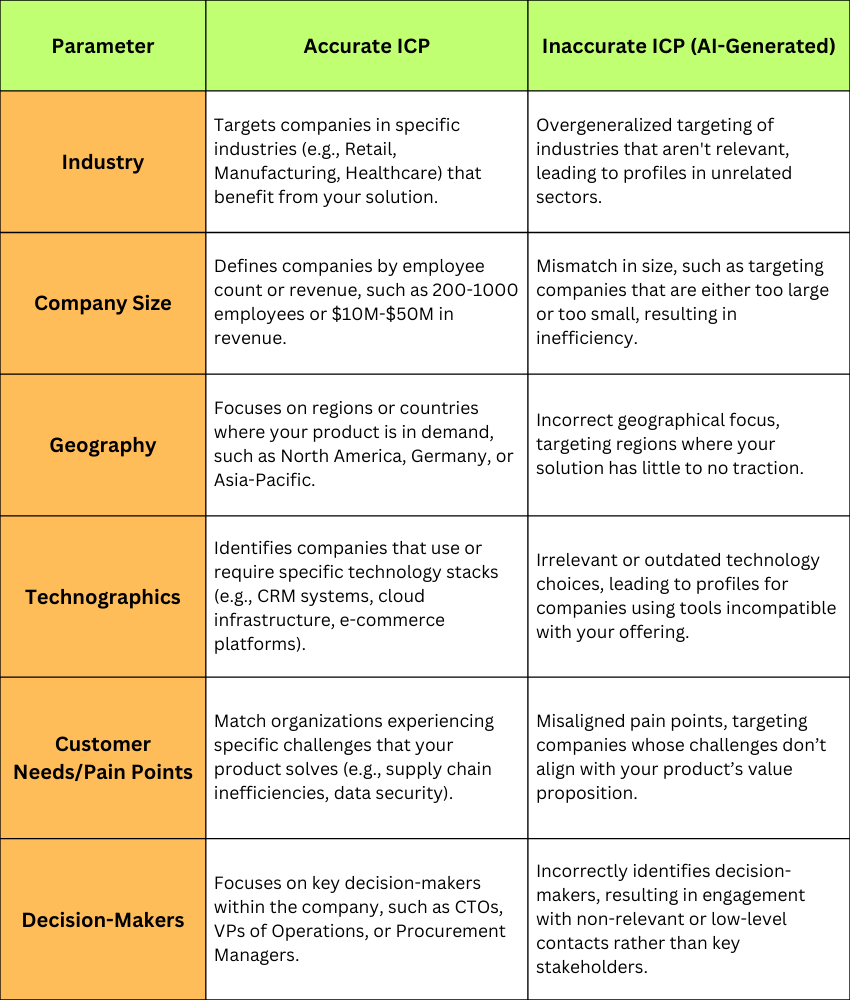
Differentiation between an Accurate and an Inaccurate ICP
The Role of Human Oversight in Ensuring Accurate ICPs
While AI can efficiently analyze vast datasets and generate customer profiles at scale, human
oversight is essential to ensure that these profiles are both accurate and aligned with business
objectives. AI relies on training data to identify patterns, which can lead to the overlooking of
key nuances, emerging trends, or market changes. Human oversight brings industry expertise,
context, and judgment to validate AI-generated profiles, ensuring that the final Ideal Customer
Profile (ICP) accurately reflects the current business landscape.
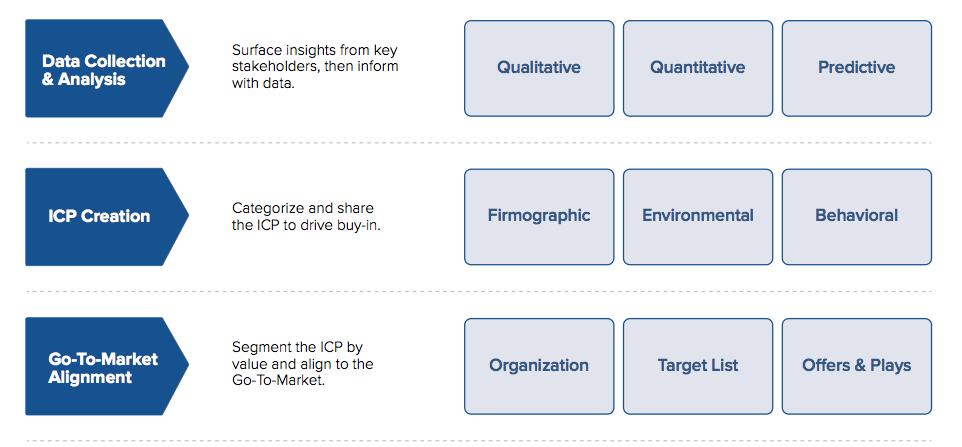
Source: Gartner
To mitigate the risk of inaccurate AI-generated ICPs and ensure their relevance, businesses should implement the following best practices:
- Data Validation: Regularly cleanse and validate data to ensure AI is working with high-quality B2B data lists. This prevents poor-quality data from skewing the ICP.
- Regular Audits: Conduct periodic audits to cross-check AI-generated ICPs against real-world sales data. This ensures that the profiles remain aligned with business objectives and are actionable for sales and marketing teams.
- Customizing AI Models: Tailor AI models to understand the specific nuances of your target market. This reduces the risk of overfitting and ensures the profiles are relevant to your actual audience.
- The Hybrid Approach: Foster collaboration between AI and human teams to continuously refine and optimize ICPs. By combining AI’s data processing power with human insights, businesses can create more accurate, actionable customer profiles that drive success.
The Strategic Imperative: Business Case of Custom List Building Services
Custom list-building services ensure precise targeting by creating lists based on a specific Ideal Customer Profile (ICP), enabling businesses to reach the right decision-makers—by job title, industry, location, or buyer intent. This tailored approach significantly enhances conversion rates, improves qualification, and increases ROI.
Additionally, custom lists enable highly personalized campaigns, fostering greater engagement with targeted buyer personas. With an up-to-date, high-quality B2B data list, businesses can prevent revenue leaks from outdated information, ensuring a steady flow of accurate leads. Custom list building creates a scalable, proprietary asset that grows with your business while ensuring compliance with privacy laws such as GDPR, safeguarding your marketing efforts, and protecting customer data.